The Health and Wellness Shift Is Not a Trend. It Is a Structural Realignment of Consumer Packaged Goods.
The beverage and CPG industry has a habit of treating health and wellness as a trend cycle. Something that rises, peaks, gets commoditized, and eventually gives way to the next thing. Low fat gave way to low carb. Low carb gave way to organic. Organic gave way to clean label. The assumption embedded in that framing is that wellness is a consumer preference that rotates like fashion, and that the smart play is to ride the current wave without over-investing in infrastructure that will be obsolete when the cycle turns.
That assumption is now demonstrably wrong, and the brands and investors still operating on it are making an expensive mistake.
Health and wellness in CPG is not a trend. It is a structural realignment of how consumers evaluate, choose, and remain loyal to products across every category they shop. The distinction matters because trends call for opportunistic responses and structural shifts call for foundational ones. Getting that wrong at the brand strategy level is the kind of mistake that does not reveal itself until it is expensive to correct.
What structural actually means in this context.
A trend is a preference that moves through a consumer population and then fades as novelty diminishes and the next preference emerges. A structural shift is a change in the underlying framework consumers use to make decisions, one that persists and compounds regardless of which specific products or ingredients are currently in favor.
What has happened in health and wellness over the last decade is structural because it is not about any specific ingredient or product format. It is about a fundamental change in what consumers believe a product owes them. A generation of consumers has grown up with access to nutritional information, ingredient transparency, clinical research, and peer communities organized around health optimization. They do not evaluate a beverage or a food product the way their parents did. They ask what is in it, what it does, whether the claims are credible, and whether the brand's values are consistent with their own.
That evaluative framework does not go away when a specific ingredient falls out of favor or when a particular product format gets crowded. It applies to whatever comes next. The brands that understand this are building for the framework, not the ingredient. The brands that do not are launching products and then watching their positioning become irrelevant the moment the ingredient they built around loses its moment in the consumer's attention.
The data that makes this undeniable.
The numbers from 2024 across beverage and CPG make the structural nature of this shift impossible to dismiss.
Non-alcoholic beverage sales grew 32% from 2022 to 2023 while total alcohol sales grew 1%. That growth rate did not decelerate meaningfully in 2024. The energy drink category crossed $21 billion in retail sales growing nearly 10% year over year even as other beverage categories contracted. Celsius built a $1.3 billion annual revenue business by positioning around fitness and wellness rather than energy and intensity. Alani Nu generated $595 million in revenue in 2024 almost entirely by serving a health-conscious female consumer the legacy category had never prioritized.
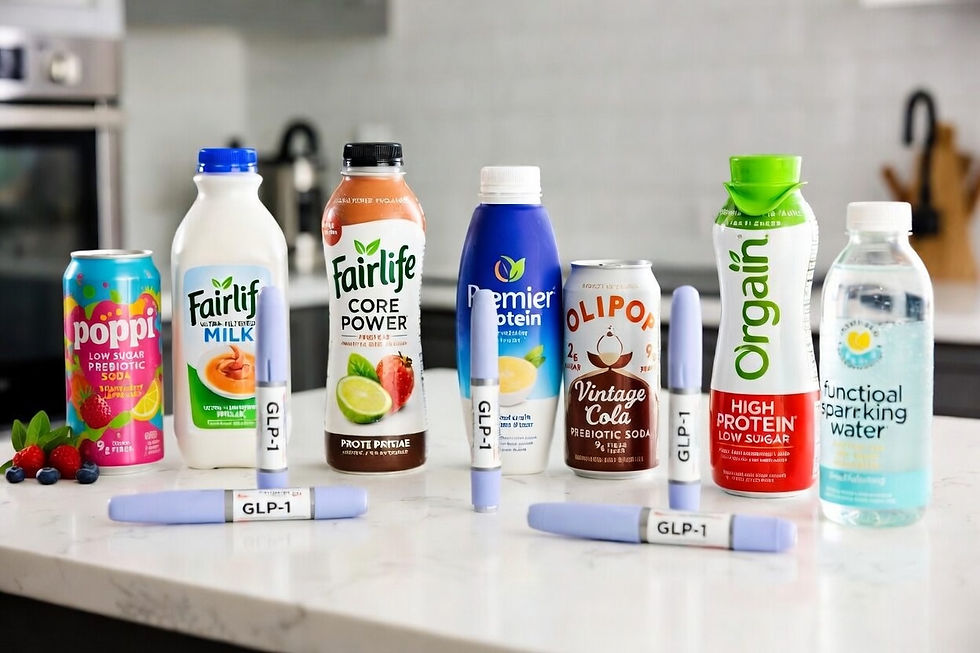
Prebiotic sodas crossed into mainstream grocery permanently. Olipop and Poppi together demonstrated that consumers would pay a consistent and meaningful premium for functional gut health benefits across multiple years, not just during an initial novelty period. Protein enriched dairy, led by Fairlife, became one of the fastest growing segments in the entire food and beverage landscape as consumers actively sought products that delivered measurable nutritional outcomes rather than just taste.
Private label health and wellness products grew faster than national brands in the same period, which is a particularly telling signal. When a consumer behavior is trend-driven, private label typically lags because the trend is partly about brand identity and novelty. When the behavior is structural and the consumer is genuinely motivated by the functional outcome rather than the brand story attached to it, they will take the store brand if the formulation delivers. That is what happened in 2024 across protein, fiber, probiotic, and functional beverage categories. The consumer wanted the outcome, not just the story.
Why this realignment is accelerating rather than plateauing.
Several forces are compounding the structural nature of this shift and driving its acceleration rather than its eventual reversal.
The first is GLP-1 medications. The rapid mainstream adoption of drugs like Ozempic and Wegovy is producing a population of consumers who are actively managing appetite, protein intake, and nutritional density in ways they never did before. That consumer does not stop thinking carefully about what they eat and drink when they come off the medication. The habits and the evaluative framework persist. Every consumer who has gone through a GLP-1 cycle is a permanently more sophisticated CPG buyer than they were before, and that population is growing rapidly.
The second is ingredient literacy. The combination of social media, health-focused content creators, and direct access to nutritional research has produced a consumer base that can evaluate a supplement facts panel more critically than most marketers anticipated. Claims that would have gone unquestioned a decade ago are now routinely scrutinized by consumers who know what an efficacious dose of a functional ingredient looks like and who will call out the gap between a marketing claim and a label reality. That scrutiny is not going away. It is intensifying as more consumers participate in health optimization communities where ingredient education is a primary activity.
The third is the demographic pipeline. The consumers leading this behavioral shift are millennials and Gen Z, who are still in the early and middle portions of their peak spending years. The structural shift in CPG purchasing behavior is being driven by the largest and most economically significant consumer cohorts in the market. As those cohorts age into higher income brackets and greater purchasing power, the influence of their evaluative framework on the broader market will increase, not decrease.
What this means for brand strategy.
The practical implication of understanding this as structural rather than trend-driven is that the investment required to win is front-loaded and foundational rather than reactive and opportunistic.
A brand built to ride a wellness trend needs a compelling story about a hot ingredient and distribution into the channels where that ingredient is currently resonating. A brand built for a structural wellness market needs a credible functional proposition supported by honest formulation, a consumer identity that is durable across ingredient cycles, and a pricing architecture that reflects genuine value delivery rather than trend premium.
The difference between those two brands is visible at the formulation stage, the positioning stage, and the pricing stage, all of which happen before a single unit is sold. The brands that get those three things right in 2025 are building toward outcomes that compound over years. The brands that get them wrong are building toward a moment rather than a business.
The opportunity in CPG right now for founders who understand the structural nature of this shift is significant. The consumer is actively looking for products that serve their health goals with honesty and credibility. They are willing to pay for them, recommend them, and remain loyal to them across years. That is a more durable foundation for a brand than any trend cycle has ever provided, and the founders building on it with the right strategic foundation are the ones who will look back on 2025 as the year they got it right.
The brands Liquid Opportunities is most excited about heading into 2025 are the ones being built around a genuine consumer health need rather than a trending ingredient. The founders who understand the difference between those two briefs are asking better questions at every stage of development, and better questions produce better brands. That is the work worth doing right now.