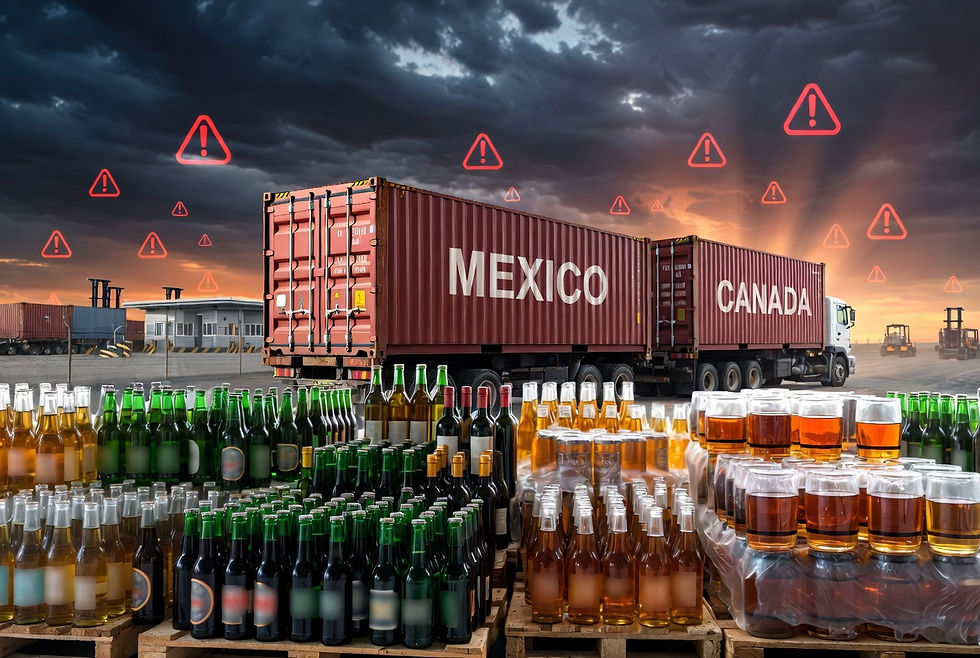
Distributor Inventory Levels Are High. Here Is How Smart Brands Are Using That to Their Advantage.
If you have been trying to get a new beverage brand in front of distributors over the past eighteen months and found the conversations harder than expected, here is the honest explanation: the trade has been working through a problem you did not create, and until recently it did not have much appetite for new complexity while it was doing that.
The problem is inventory. And understanding it precisely is the first step toward using it to your advantage.
What Actually Happened
The pandemic created a three-year demand super-cycle across beverage alcohol. Consumers at home spent more on premium spirits, wine, and RTDs than anyone had modeled. Distributors responded rationally by building inventory levels to service what appeared to be durable structural demand. Suppliers shipped aggressively to meet that demand. The entire supply chain optimized for a version of the market that turned out to be circumstantial rather than permanent.
When demand normalized in 2022 and 2023, the trade found itself with inventory levels that had been calibrated for a market that no longer existed at that rate. The result: sell-in from manufacturers began running below sell-out to consumers as distributors worked down excess stock before placing new orders.
The TD Cowen analysis of US Census data tracked this in real time through 2023. Merchant wholesaler inventories for total beverage alcohol peaked at 1.68 times sales, running 24 percent above the seven-year average of 1.36 times. Through the second half of 2023, six consecutive months of decelerating inventory growth signaled that the correction was underway. By August 2023 the ratio had declined to 1.65 times, then 1.65 times in the fall, with Jefferies confirming the gradual moderation. The direction was encouraging. The absolute level remained elevated.
What that meant in practice was that distributors had limited appetite for new SKUs. A distributor working through excess inventory of established brands has less warehouse capacity, less sales team bandwidth, and less organizational patience for unproven products demanding attention. The window for new entrants was effectively narrowed by a problem that originated at the supplier and distributor level long before the new brand arrived.
Why Early 2024 Is Different
The inventory normalization that was underway through the second half of 2023 is continuing into 2024, and the strategic implications for new brands are shifting as a result.
As inventory levels approach historical norms, distributor capacity reopens. Sales teams that were focused on moving through excess stock of established brands begin looking for growth again. And the most forward-thinking distributors, the ones thinking about what their portfolio looks like two and three years from now rather than just managing today's P&L, actively want to add brands that can grow with them as the category normalizes.
That shift creates a specific window that well-prepared brands can enter deliberately. It is not a window that will be open indefinitely. Once inventory normalizes fully and demand signals clarify, the trade will reassert its conventional preference for established brands with proven velocity over new entrants asking for shelf space and sales attention. The current moment, where distributors are emerging from a correction and looking forward rather than managing backward, is genuinely different from what the previous two years looked like.
What Smart Brands Are Doing Right Now
The brands that are using this environment well share a set of behaviors that are worth understanding specifically.
The first is that they are doing the work to understand the distributor's actual situation before they walk in the room. A distributor conversation that opens with how great your brand is will go nowhere if the distributor is sitting on eighteen months of excess Cognac inventory and a beer portfolio in decline. The conversation that gains traction starts with an acknowledgment of what the distributor is managing and a clear articulation of where your brand fits in their specific portfolio gap.
Every distributor portfolio has categories that are working and categories that are not. Every distributor has accounts they want to grow that they cannot currently service with what they carry. The new brand that walks in with a clear answer to the question "where do I fit in what you are already trying to build" has a fundamentally different conversation than the brand that leads with its own story.
The second behavior is prioritizing market concentration over market coverage. One of the most common mistakes new beverage brands make is trying to establish distribution across too many markets simultaneously, driven by the false comfort that broad distribution means the brand is working. What it usually means is that the brand is spread too thin to build real velocity anywhere, and the distributor in each market has too little incentive to push it because the territory commitment from the brand is insufficient.
In a tight inventory environment, concentrated market depth is even more important than usual. A distributor who sees a brand generating genuine pull in a defined geography has a reason to invest. A distributor carrying a brand with thin velocity across a wide footprint has no reason to prioritize it over everything else competing for the same attention.
The third behavior is using the current environment to negotiate better terms than would have been available during the peak of the cycle. When the trade was flush with demand and distributors had the power to dictate terms, new brands accepted onerous minimum commitments, aggressive depletion requirements, and limited support guarantees just to get in the door. In the current environment, where distributors are actively rebuilding their portfolios and looking for brands with upside, the negotiating dynamic is more balanced. The founders who recognize this are securing better territory agreements, more specific support commitments, and clearer performance benchmarks that protect both sides.
The On-Premise Opening
One of the most consistent findings in the post-pandemic data is that on-premise recovery has been uneven in ways that create specific opportunity for new brands.
CGA by NIQ data from late 2023 showed on-premise spirits sales down 3.3 percent by volume for the 52 weeks through early September, with value and mid-range spirits recording declines of 8.6 and 6.4 percent respectively. But ultra-premium spirits actually grew 3.5 percent in the same period, and states including New York posted 3.9 percent volume growth while the national trend was negative.
What that data tells a new premium brand is that the on-premise channel is not uniformly difficult. It is specifically difficult for value and mid-range brands in markets that have faced the most consumer spending pressure. For premium products in markets with strong on-premise culture and affluent consumer bases, the channel is performing. And the on-premise remains the most important place for a new brand to build the consumer relationships and visible credibility that eventually drive off-premise velocity.
The distributor who sees a new brand earning genuine on-premise placement in quality accounts, with bartenders recommending it and consumers reordering it, has all the evidence they need that the brand deserves more of their attention. On-premise pull is still the most powerful signal the trade recognizes. In an environment where distributors are evaluating which new brands to add as they rebuild, a brand with documented on-premise performance is operating with a different level of credibility than a brand asking to be taken on faith.
What to Avoid
The strategic opening that a normalizing inventory environment creates is real. So are the mistakes that brands commonly make when they interpret it incorrectly.
The most common mistake is confusing distributor availability with distributor engagement. A distributor who has more capacity than they did eighteen months ago is not automatically a distributor who will work your brand. Capacity is the entry requirement. Engagement requires demonstrating that your brand will generate the kind of pull that makes their sales team want to pick up the phone on your behalf.
The second mistake is moving too quickly into secondary markets before proving the model in the primary one. The normalizing inventory environment will reward brands that build genuine proof of concept in a defined geography. It will not reward brands that spread thin distribution across multiple markets on the assumption that coverage equals momentum.
The third mistake is treating the current window as permanent. The inventory correction will complete. The demand environment will stabilize. When it does, the trade will return to its default posture: risk aversion, preference for established brands, and limited patience for unproven entrants. The founders who use the current moment to build documented pull, earn genuine distributor relationships, and establish real on-premise credibility will enter that normalized environment with assets. The ones who are still asking for a chance when the window closes will find the conversation much harder.
At Liquid Opportunities, the distributor relationship is one of the three or four decisions we spend the most time on with every brand we work with, and the sequencing of that relationship matters enormously. When to approach, which distributor, with what proof points, and with what ask — these decisions in the wrong order can set a brand back by a year or more. In the current environment, with inventory normalizing and the trade beginning to look forward again, the brands that have done the preparation work are walking into the most receptive distributor conversations in two years. The preparation is the difference between using that window and missing it.